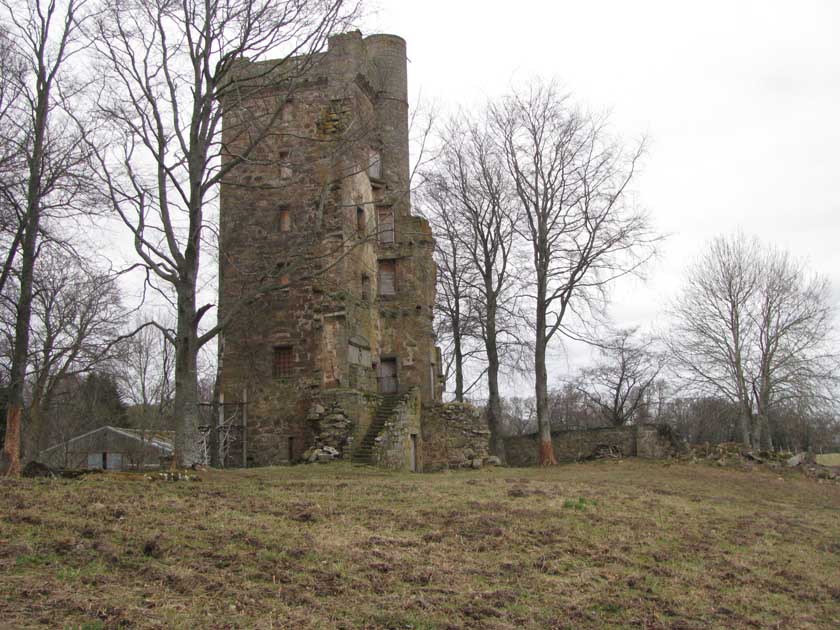
Burgie Castle
Burgie Castle Details
Burgie Castle, one tower of ruined C16 tower house of Dunbars maintained with roof but not accessible to public
- Closest To: Forres, Kinloss
- Access: Occasional Access
- Grid Reference: NJ094593
Burgie Castle is a tall tower standing on a low rise within a walled enclosure. It is not accessible from public roads but visible from adjacent lanes by pedestrians. On occasion the tower has been opened to the public, but numbers were strictly limited.
The tower is the surviving part of an extensive mansion and courtyard incorporating a Z-plan tower house of the 16th century. It was built for members of the Dunbar family, who acquired the property from the Abbey of Kinloss at the Reformation through a relationship with the Dean of the chapter of Elgin Cathedral – also a Dunbar. By 1598 Robert Dunbar, the son of the Dean, held the estate, and was almost certainly responsible for the erection of the tower house – a fireplace lintel from the great hall can be seen bearing the date 1602. Robert was wealthy enough to loan the heir to the earldom of Huntly 12,000 merks by 1627. In 1640, he was succeeded by his son, another Robert, who suffered disaster when the army of Montrose sacked his estates in 1645. In order to avoid sequestration, he issued a charter to his own son, another Robert, in 1649, but the measure was unsuccessful, and this combined with a lack of royal favour to keep him in prison for six years. In the end he was forced to sell the estate in 1668 to his cousin Thomas Dunbar of Grange, who moved in, to Robert junior’s disgust.
Thomas had to eject Robert soon after, as Robert had forced entry, at which point Robert joined the army and disappears from record. Thomas was unable to restore the estate finances, and it is likely that the house went into decline, although it was still standing intact in 1799. Thomas suffered financial penalty for opposing the reintroduction of Bishops to Scotland, being fined £1000. It is no surprise that he was a supporter of William and Mary’s accession to the throne in 1689. He died in 1693, and his son Ludovick was responsible for erecting a new home, named Burgie House, before his death in 1725, leaving a seven year old son Joseph, who lived until 1794. By 1788, he wanted to sell the estate, but failed to do so, and his son Lewis elected to demolish most of the castle between 1800 and 1802, using the materials to extend Burgie House – or else build one anew.
Become a supporter of my work to access a more detailed history