Brims Castle
Brims Castle Details
Brims Castle private and unoccupied C16 tower house of the Sinclairs extended C19 and occupied to C20. Dangerous property.
- Closest To: Scrabster, Thurso, Forss
- Access: No Access
- Grid Reference: ND043710
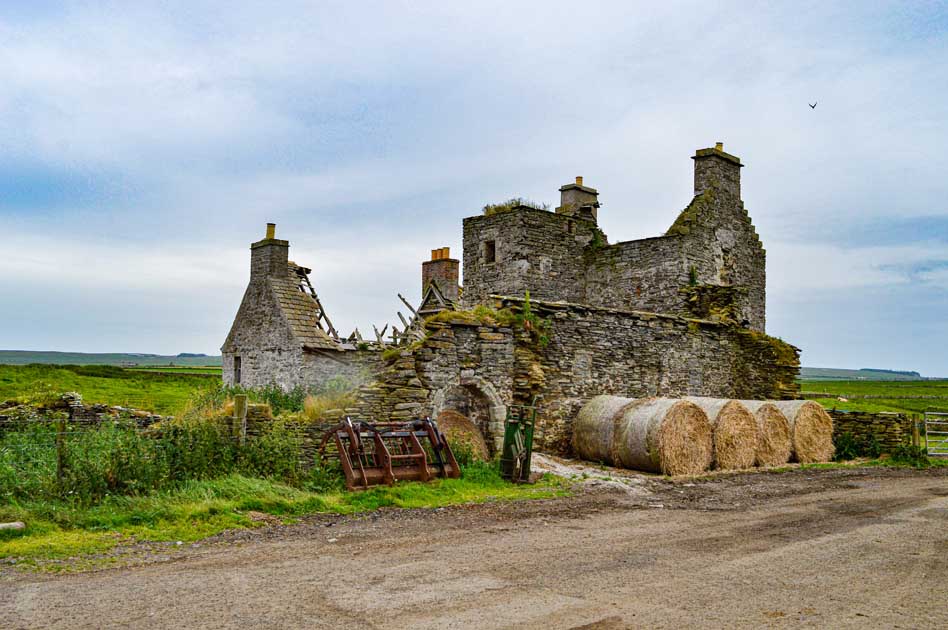
Brims Castle is a tower house, courtyard and house all of which are derelict and in a dangerous condition – and no attempt should be made to access the interior. The castle sits at the edge of a working farm overlooking a landing place on the northern coast of Caithness – and on the far side of the farm is a ruined chapel, indicating the presence of a small settlement at one point.
The lands of Brims were almost certainly part of the lands that were ranted to the Bishop of Caithness in the 12th century, and were farmed out by the Bishop to various individuals whose names are lost to history. In 1546 the man who was leasing the lands was Walter Innes of Thursater, the vicar of Thurso. He was followed by William Innes, perhaps his son, although William was “portioner” indicating the lands were split between heirs at this time. Williams son Robert married a grad-daughter of the earl of Caithness, and in 1573 the Lady Barbara Sinclair had lands in life rent amongst others – although not necessarily the whole estate. Towards the end of the 16th century the lands were held by Henry Sinclair of Broubster, whose father was William Sinclair (II) of Dunbeath, and whose mother was Margaret Innes, a daughter of the laird of Innes in Moray. Conceivably Margaret may have been another portioner of the lands. By 1610 Henry was dead, and he was followed by his brother Richard, who was dead by 1647, and Richard by his grandson John, who sold the lands of Brims to John Sinclair of Tannach.
It is likely that the earliest building here was a three storey strong house, accessed by a first floor entrance in the west gable, which had a narrow winding stair in the south-eastern corner. The basement was vaulted, and the building might be considered more of a bastle house than a castle. This was probably the seat of the Inneses, and it is likely that the house was reworked by Henry Sinclair with the addition of a stair wing on the southern end of the east wall – with a new first floor entrance facing east. The old entrance was converted into a window. This in turn was extended upwards a storey, probably by Henry or Richard Sinclair, and a caphouse added at the top of the stair wing accessed by a projecting turret, surviving as an open bartizan over the east entrance. There was probably a courtyard with buildings around it at this time as well.
John Sinclair of Tannach bequeated Brims to his younger son Patrick, who sold Brims to the 9th earl of Caithness in 1726, who probably used it as his house until a new property had been finished at Haimer, south-east of Thurso. On his death in 1764, the lands of Brims were entailed to a new branch of Sinclairs, who domesticised the property by adding a large kitchen to the north side of the tower, and then erected a new house on the east side, which was extended and connected to the tower by a covered pend. The property remained inhabited until the 1970s, and in the 1980s the roof was deliberately collapsed – perhaps to anticipate an accidental cave-in.