Bridge Castle
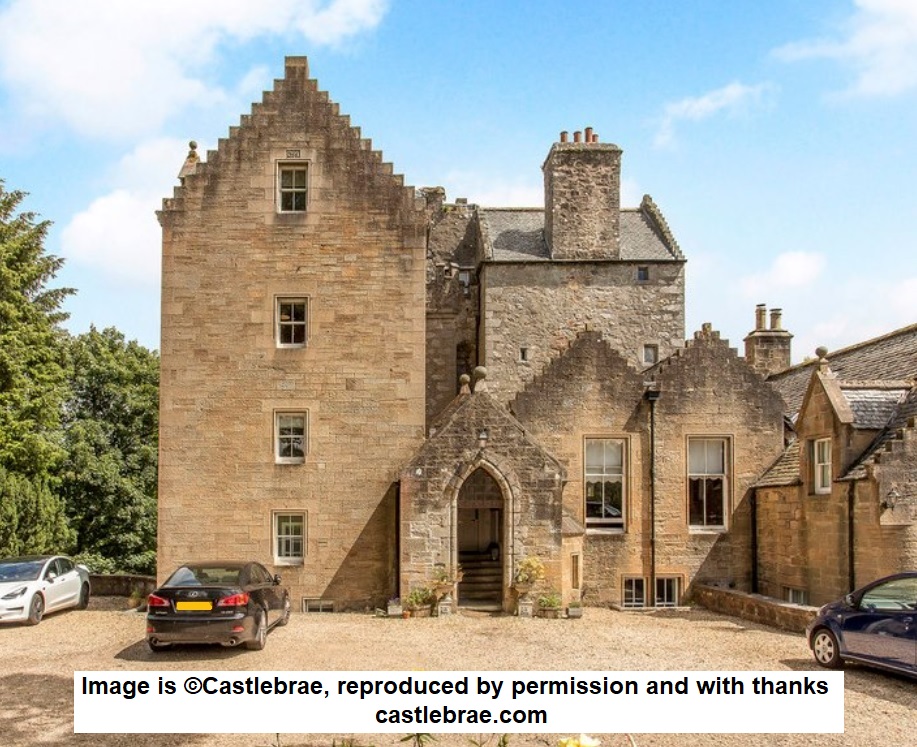
Bridge Castle Details
Bridge Castle, privately occupied C16 tower of the Stewarts & Livingstones, extended C17 and C19 by the Hopes
- Closest To: Torphichen, Westfield, Armadale, Bathgate
- Access: No Access
- Grid Reference: NS944710
Bridge Castle is a privately occupied and much altered tower house dating to the 16th century originally. It is sited on the west side of the Barbauchlaw Burn, which flows generally northwards to join the West Lothian River Avon, and is now subdivided into a number of private residences, which cannot be seen from the public road. Approximately a mile and a half north-east is the village of Torphichen, which was the Scottish headquarters of the Knights Hospitaller.
The lands of Bridgehouse were part of the lordship of Ogilface” which first appears in records as having been granted to William de Vieuxpont, whose descendant (also William) granted them to Holyrood Abbey in the reign of William I. The Abbey, in common with many others in like position, retained the superiority of the estate, but granted it out piecemeal to various parties. The officers of the Vieuxpont family may have continued to administer the estate on behalf of the abbey, since in 1330, Mariota de Vieuxpont, the heiress daughter of that William de Vieuxpont who had been killed at Bannockburn, married Alexander Cockburn, a prominent Berwickshire baron, and the Cockburn laird of Clerkington, descended from this Alexander, sold the superiority of “the lands of Ogilface” (presumably his part of the old barony) to William, 6th Lord Livingston, in 1590. A disposition dated 3rd March 1578 records that Elizabeth Hamilton, the widow of Robert Wotherspoon of Brighouse, disponed an annual grant of £20 Scots from the lands of “Mekle and Little Brighouse” to Andrew Stevenson, merchant in Edinburgh. In return for a payment of 200 merks, Alexander Stewart of Scotstounhill paid Stevenson off, and gained the lands for himself. Robert was known as laird in the mid 1550s, and tin one record it is stated that one in favour of James was signed “at the place of Brighouse, in the hall thereof” in the late 1550s, confirming the presence of a high status residence at Brighouse in the mid 16th century. A separate 1568 document is dated “at Brighouse, in the garden near the keep” which confirms that a tower formed part of this residence by 1568.
In a charter dated 1588, there is a mention of the fortalice of Little Brighouse. This charter is a confirmation from King James VI to Alexander, 7th Lord Livingston of Callendar and later 1st Earl of Linlithgow. The granters include Alexander Stewart of Scottistounhill and his wife Elizabeth Hamilton, their eldest son James Stewart and his wife Helen Sinclair. It may be the case that Stewart had married the widow of Robert Wotherspoon and adopted her son, but what is clear is that the tower of Brighouse was occupied by Stewart and Elizabeth Hamilton, and then sold it to Lord Livingston. It seems possible that the family then remained as residents in the tower, perhaps a lifelong residence of the “elderly” Elizabeth. The original tower at Bridge was a rectangular tower-keep, with an entrance doorway towards the western end of the southern wall. The ground floor of the tower is vaulted, with a fireplace in the west gable, double slit windows in the east gable, and a small window opposite to the entrance door. The entrance doorway leads out to a lobby area, with stairs leading down to a 19th century porch to the west, a second door leading south into the vaulted ground floor room of the later tower (a lintel bears the date 1656), and at the north end of the lobby is a later staircase contained within a square extension, and the back door of the property off this. The whole house was extended and remodelled on multiple occasions, and was given a large baronial extension in the 1880s.
Sir James Livingston was the younger brother of the Earl of Linlithgow. He appears on records as James of Brighouse from 1615. It is to be presumed that he was resident in the castle, and he had a turbulent career, being created Sir James Livingston of Livingston in 1626, Lord Almond in 1633, and 1st Earl of Callendar in 1641. He was active throughout the wars of the mid 17th century, was forfeited in 1654 and imprisoned until the Restoration. He died in 1674 with no children, his estates passed to his nephew Alexander, 2nd earl of Callendar. Bridgehouse remained a secondary seat of the earls of Callendar until their forfeiture after the 1715 Jacobite Rising, the last being James (IV) from 1692, who also inherited the Linlithgow title in 1695. He died in exile in Italy in 1723, by which time Brighouse had been acquired by the Hope family of Hopetoun, who retained the house into relatively recent times. In the 1970s it was run as a hotel, but then fell into disuse, and is now privately occupied, having been converted into a number of separate self-contained properties.
Become a supporter of my work to access a more detailed history