
Bonshaw Tower
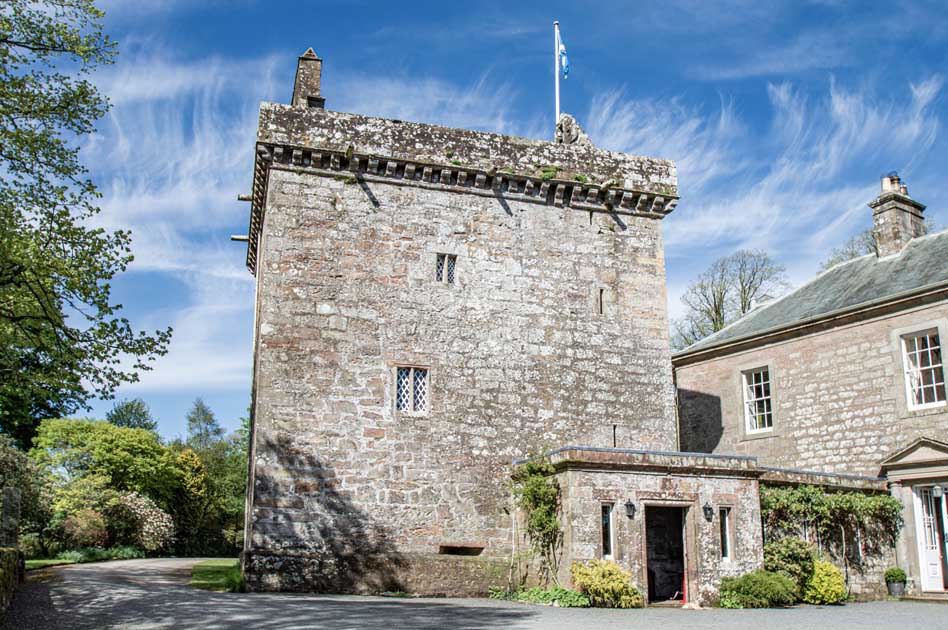
Bonshaw Tower Details
Bonshaw Tower, C16 tower of the Irvings still occupied by that family and available to hire as a venue
- Closest To: Kirtlebridge, Eaglesfield, Kirkpatrick-Fleming
- Access: No Access
- Grid Reference: NY243720
Irving Tower is an intact rectangular tower house of the Irvings, built in the 16th century and replacing an earlier castle which may have been on a different site – potentially the old fortified promontory to the south-east. It sits adjacent to the later mansion house erected by the Irving family in 1770, and is within private gardens which cannot be seen from public roads.
The Irving family are said to have held the lands of Bonshaw since the time of Robert Bruce, but this tradition is unsubstantiated. The earliest reference to Bonshaw is not until 1506, and a reference to an earlier document which does not survive but was dated 1484. The Irvings of Bonshaw were heads of the family in the Borders, and were one of the most important families in Dumfries-shire in the 16th century. An earlier version of Bonshaw was burned down in 1544, and repaired – only to be damaged by artillery in the latter 1560s. In 1570 the current tower was built. It overlooks a steep cliff and the Kirtle Water, and although there are no surviving remains today, there were probably outer earthwork defences as well, although there is no evidence or knowledge of a barmkin courtyard. By 1582 there was a gate – which suggests there was a courtyard, and this may have been to the south and east overlooking the river cliff. The Irvings were involved in a deadly feud alongside the Johnstons who were their feudal superiors; the target of their fury was the Maxwell family, who besieged Bonshaw unsuccessfully twice, and threatened it twice more.
The tower is well-preserved with a vaulted basement accessed from outside as well as through a tiny trapdoor in the roof. It retains the sloping floors that remind us of the original use to protect livestock from raiders. There is also a prison in the south-west corner, and four gunloops. The entrance was protected by a door and yett, and the stairwell opens right next to this, leading up to the wallhead. The first floor hall has a large fireplace, the second floor principal chamber has a garderobe which was flushed by rainwater from the roof, which is remarkably civilised! Above, the attic is lit by rooflights; the stair leads through an awkward angle up to the wallwalk through a narrow door. The north gable retains the warning bell and tower. The entrance to the tower is now behind a 19th century link block connecting the tower and 18th century house.
The Irvings retained the tower until 1870, although not always by direct male descent. King James VI actually stayed here a night in 1602 when on campaign against the lawless men of the region. The long-lived “Wild Bonshaw”, James Irving, was laird from 1647-1682, and died without issue. An extensive legal case was not resolved until 1696, and a new line of Irvings ensued. In 1770, the area around the tower was cleared and the new house built, together with a fancy new entrance to the tower. When John Irving died in 1839, he left no male heirs, and the successor, Rev John Irving, followed this pattern in 1870, and his successor left the estate to his housekeeper in 1894, leading to another legal battle. Today, the castle tower is available to use as a venue, the adjacent house remains a private residence, acquired in 1986.