
Bass Castle
Bass Castle Details
Bass Castle, remains of C16 -C18 artillery fort on site of earlier castle on the Bass Rock dating to at least 1405
- Access: S.O.A.C. Public Access
- Grid Reference: NT602873
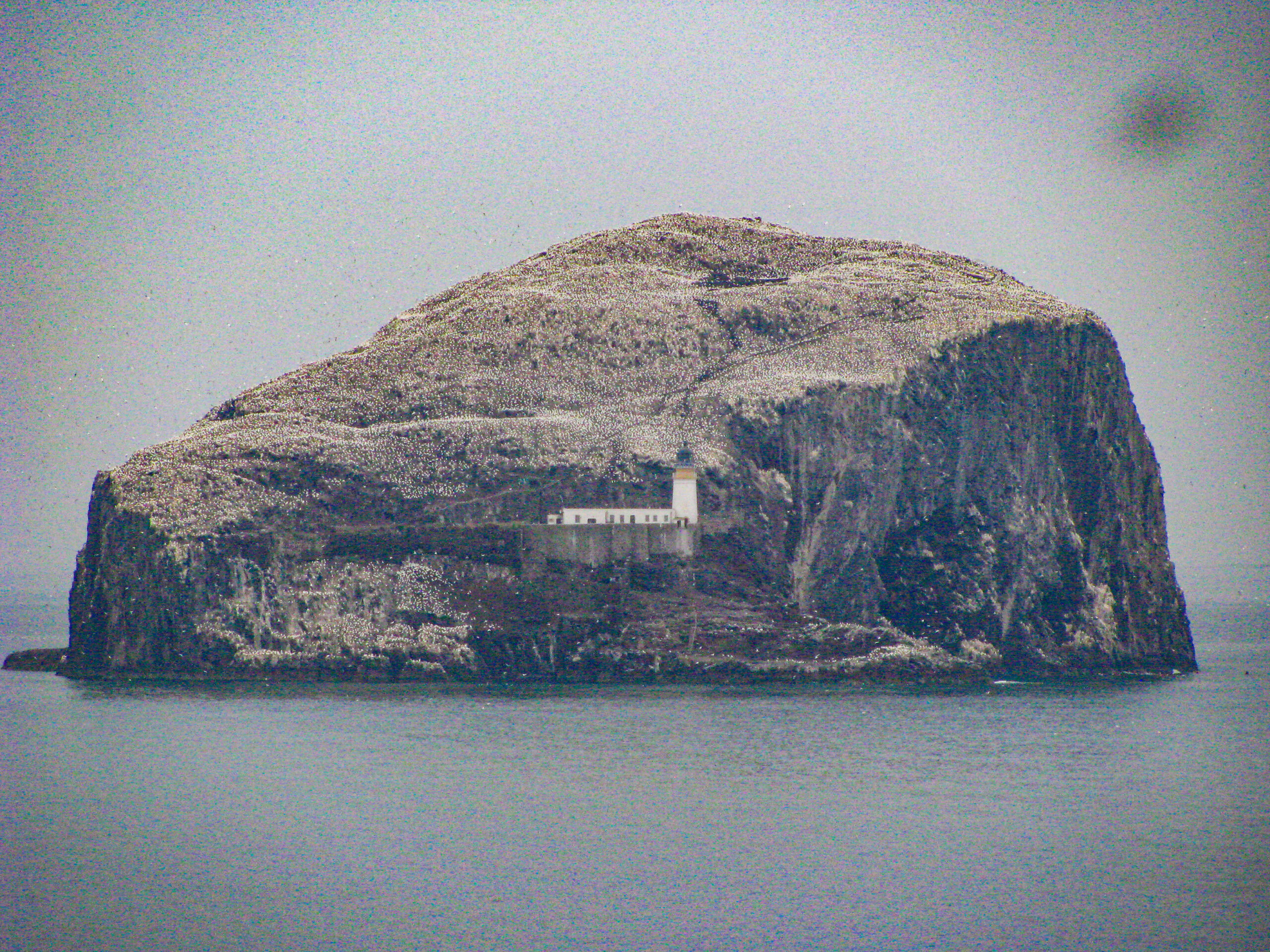
Bass Castle is the name given to the fortification on the Bass Rock, a very conspicuous rocky island in the Firth of Forth. The Bass Rock is about a mile offshore, and the crown of the rock is over 100 metres above sea level. The sides of the rock are very steep, and the only viable landing point is on the southern side from the east, where there has been a dock for centuries.
The Rock is believed to have been a monastic retreat and the superiority of the lands was held by the Priory of St Andrews in the early 14th century, when Robert of Lauder obtained a charter to one half of the Bass from the Bishop and Prior. This dated to 1316, and the Lauders remained associated with the Bass for centuries. The Bass was used to house dangerous state prisoners, Thomas Earl of Mar being imprisoned there at the order of King David II after allying with the English. In 1403, Prince James was sent to France for his safety ands education by his father Robert III, and embarked from the Bass in 1405. With ironic symmetry, when James returned as king in 1424, it was to the Bass that he sent Walter Stewart, the eldest son of Murdoch of Albany, when it is described as the king’s castle. In 1491, the church of the Bass was built – or rebuilt as the church still retained ownership of half the island – which led to disputes between the Lauders and the church. From time to time the Bass was actually granted to other individuals at the whim of the political situation of the time, but the consistent name outside of these is the Lauders. Although decreasing in importance, the castle was still used as a prison even after the Union of the Crowns in 1603, as there are records of prisoners being transferred there as late as 1645. By 1657 the garrison was a mere 18 men, and the Lauders had finally been replaced as keepers. However the Jacobite period saw a late resurgence, and the castle was held by rebels from 1688-1690. In 1701, the defences were demolished, and six years later it was granted to Sir Hugh Dalrymple, whose descendants still own the island today.
As the defences were demolished, and is now the site of the 1902 lighthouse, it might be thought there is comparatively little left of the castle to see. However, examination of Slezer’s image shows what it was like in the 17th century as an impressive artillery fort. It is clear that the massive retaining wall of the upper enclosure has survived to serve the same purpose for the lighthouse, and the east facing wall and gate also survive. Predominantly, when one landed at the shore, one looked up at a solid mass of walling with a central gate, accessed via steps or a ramp, and with a round tower at the southern end. Out of sight, a retaining wall then provided defence to the southern side where the slope was more accessible, and this overlooked a second docking area with a crane for the provision of supplies. This was provided with artillery when that developed as a weapon, and there were gun-loops in the tower. Passing through the gate(and probably up some stairs) one was on a level courtyard, overlooked by a second massive battlemented wall with projecting bastions/towers, again bristling with cannon in later years. A two-storey building acted as gate for the upper enclosure, similar to the original entrance to Edinburgh Castle’s citadel but on a smaller scale. Behind this was a tower-keep overlooking the eastern defences, later named the Governor’s House, and to the other end was the barracks and prison.
Today it is possible to visit the Bass Rock by booking a boat trip – there are multiple operators.