
Boltongate Rectory
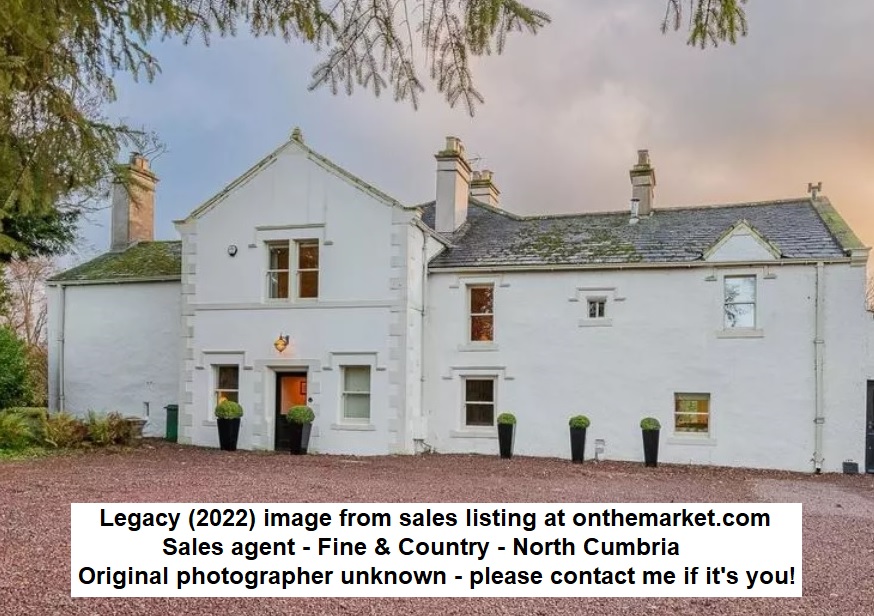
Boltongate Rectory Details
Boltongate Rectory is now a private house, but contains within it the remains of a 15th century tower house, extended in the 17th and 19th centuries.
- Closest To: Boltongate, Ireby, Bothal
- Access: No Access
- Grid Reference: NY22964063
Boltongate Rectory is a private residence hidden behind mature trees within the hamlet of the same name and to the south of All Saints church. The house was originally a defensive tower of the 15th century commonplace in the north, but was extended in the 16th and 17th centuries and substantially remodelled in 1889. Sales literature from the recent (2022) marketing of the house demonstrate that there is virtually nothing recognisable of the old tower within the modern building. In the 1960s, there were traces of the old internal staircase and a slit window, as well as one vaulted room, but neither feature was highlighted in the brochure.
However, it is possible to confirm that the old tower survives as the low two storey “extension” on the eastern side of the house, which is entirely invisible from the road. Internally nothing can be seen of the changes that have taken place except for the earlier pitched roof being visible in the first floor room At ground floor level are two doorways, one in the east gable, the other on the northern wall, where a photograph used outside the main brochure shows a slit window adjacent to it. The marketing brochure claims that the old tower was in existence c1380- but gives no references for this. The shouldered top of the gable door may date to this period, however. Indeed, the term “old tower” may be a bit on the extravagant side for the surviving building, which was only ever two storeys tall, and is more likely to fit the description of a bastle than a tower, and it seems likely that the barrel vault is now hidden behind a suspended ceiling, as it does not appear in the photograph which I believe shows the ground floor room.
It is also the case that a reference to a “Tudor-arched doorway” (Listing report) is used to imply the presence of a 16th century passageway which might indicate that at one point there was a more complex manor here, perhaps even a hall with solar tower, but evidence is scant to say the least. In 1293, the rector was Simon de Jesemwy – and it is notable that the lord of the manor of Bolton at that date was Robert de Bruce, the later king. By 1310 Bruce was no longer the lord, it was Roger de Mowbray, the result of Bruce’s assumption of the throne of Scotland. In 1353 the rector is recorded as William de Ebro – presumably York – and the next recorded is Adam de Crosby in 1361 – appointed from York as well. In 1535, the rector was George Neville, perhaps a son of the 2nd Lord Latimer, and details of the value of the rectory at that point have survived – clearly a preparation for the reformation of the church that commenced in 1538. By 1567, the rector was one William Turner, appointed by George Porter of Weary Hall, and in 1665 the rectory had been purchased by William Fairfax from Joseph Porter, George’s eldest son. After this, a number of rectors are known, often appointed by the Porter family, who erected a seat at Bolton. However there is nothing to suggest who it was that carried out the extensions.
I have been unable to find the details of the original photographer; no deliberate breach of copyright is intended. If you are the photographer, please get in touch.
Become a supporter of my work to access a more detailed history